Plaster Repair
Cracked and sagging old plaster pulled back tight and skimmed, or stripped out for new board once its lath gives up.
Lansing Elite Drywall provides drywall repair and installation in Portland, MI, and handles plaster and drywall replacement in Portland houses, apartments and storefronts.
Request a quote
Leave a name, a number and a line about the job. We will ring you back.
Three homes in four here were built before 1980, so most painted plaster may carry lead paint under the newer coats. Before we sand or cut it, we treat it as lead: plastic on the floor and doorways, misting instead of dry sanding, a HEPA vacuum, and the debris bagged on site. The federal lead-safe rules for pre-1978 homes ask for the same.

Older Portland houses often have tall ceilings and deep crown molding. A crack along the crown gets cut back and filled without pulling the molding, which rarely comes off old plaster in one piece.
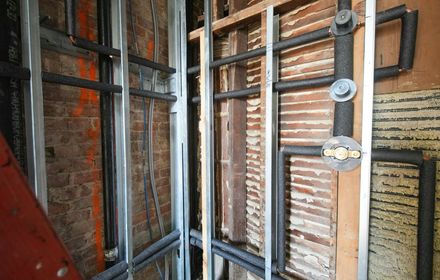
In plenty of houses from before 1940, the wall studs run in one piece from the foundation to the roof. So when we open a wall like that, we add wood blocking at the floor line. Then the cavity stops acting like a chimney for drafts or fire.
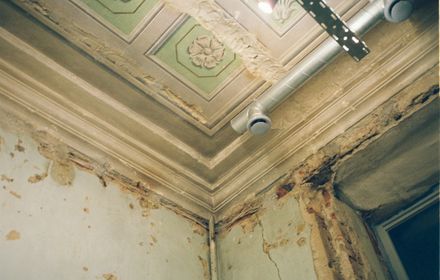
Old cast iron drains and worn tub seals can leak slowly into the ceiling below for years. Once the plumber has fixed the source, we open up the stained area. We check the lath for rot, then close it with new board.
Here’s the thing about old walls. Plaster on wood lath often runs nearly an inch deep, while standard drywall is 1/2 inch. Hang the new board straight on the studs and your door and window casings end up sticking out past the wall. So we fur the studs out with wood strips, or put up two layers, until the new surface lines up with the old trim. The casings never have to move.
Some older houses here have pocket doors that slide into the wall between two rooms. The wall above that pocket has no studs in the middle. Which means its plaster cracks and comes loose sooner than the walls next to it. If the door drags or jumps its track, that wall usually has to be opened. We cut along the old framing above the door so the carpenter can get at the track. Then we close it with board shimmed to the plaster’s depth and short screws, so nothing pokes into the pocket and scratches your door.
Portland hands its building, electrical, plumbing and mechanical inspections, and the permit paperwork too, to Municipal Inspection Services of Grand Ledge. A small plaster or drywall patch rarely needs a permit. Taking out a wall, finishing a basement or a remodel may, so ask City Hall on Kent Street first.
From Lansing, Portland is about 30 minutes west out I-96. The city sits right where the Looking Glass River runs into the Grand.
We also serve Williamston, MI, east of Lansing on the Red Cedar River and Grand River Avenue.
Portland has a population of about 3,770. Here is what that means for the work we do here.
| Local fact | Detail |
|---|---|
| Homes built in 1939 or earlier | 38.3% of the city's 1,611 housing units, with 1957 as the median year built. |
| Homes built before 1980 | 75.9%, so most painted walls here predate the 1978 ban on lead paint. |
| Homes in buildings of 5 or more units | 16% of the city's housing units, more than in Potterville, Williamston or DeWitt. |
| Building permits | Handled by Municipal Inspection Services of Grand Ledge, under contract to the city. |
| Rivers | The Looking Glass River joins the Grand River in the city, which calls itself the City of Two Rivers. |
Cracked and sagging old plaster pulled back tight and skimmed, or stripped out for new board once its lath gives up.
Brown rings, soft spots and drooping ceilings after ice dams, split pipes, bathroom leaks or basement water, opened, dried out and rebuilt to blend in.
Cracked seams, corner gaps that open every winter, sagging board, cracked plaster and holes left by fans or plumbers, repaired after the cause is found.
Seams finished to whatever level your paint and lighting demand, textures matched or applied, and skim coats that turn rough or textured walls smooth.
Lower-level rooms boarded and finished once the foundation is dry, moisture-resistant sheets at slab level, Lansing permit in hand.
Office suites, shops, clinics and multi-unit housing framed and hung per the plan set, rated walls to their tested design.
Acoustic texture sampled, misted and scraped off, then the bare ceiling skimmed smooth for primer.
Describe the room and what happened to it. We call back with what the repair or hang probably involves and which details push the number up or down.
Usually we don't have to move it. We work in from the sides and from above with narrow knives, and a mirror to see behind. If the radiator does have to come off the wall, a plumber drains it and moves it first.
We can leave the wall open for an insulation crew, or fit batts ourselves before the new board goes up. Old walls often have no insulation at all. So an open wall is a good time to add it.
Yes. We frame the gap level with the old wall surface and fill it with board shimmed out to the plaster's thickness. Then we blend the edges, and once it's painted you won't find the spot.
Window and door corners are where the house moves most, so the plaster splits on a diagonal there. We screw the loose plaster back, bridge the crack with mesh tape and setting compound, then skim it flat.
Yes. Those rooms under the roof often show cracks where the slope meets the short knee wall. We reattach or replace the loose plaster and check the roof side for a leak before we close it.
Yes. Upstairs units in the older downtown buildings often share walls and stairs with a shop, so we agree on hours with both the tenant and the business below.
Ringing (517) 940-8317 gets you a first figure fastest. Otherwise fill in the form and expect a callback.